
GPT vs Claude vs DeepSeek: One Group Chat to Compare Them All
Table of Contents

You Know This Feeling
You ask ChatGPT a question. It gives you a confident, well-structured answer. But deep down, you’re not sure — is it actually right?
So you open Claude and ask the same thing. You get a slightly different answer. Then you try DeepSeek. Yet another version.
Now you have three answers across three browser tabs. You start switching back and forth, copy-pasting, cross-referencing in your head.
You probably do this every week without thinking twice — because there’s no better way.
There Is a Better Way
Imagine this: you create a group chat, add Claude, GPT, and DeepSeek to it — just like adding coworkers to a group. Then you send one message and @ all of them.
Three AIs answer at the same time. All responses appear side by side in the same chat window.
No tab-switching. No copy-pasting. No mental juggling. One group, one question, N answers, all in one place.
That’s what vicvic.im does.
A Real Example
A classic debate: What’s the most valuable programming language to learn in 2026?
The old way: open ChatGPT and ask, open Claude and ask, open DeepSeek and ask, compare by yourself.
The new way: create a group, add all three models, send one message —
@Gemini @DeepSeek @Claude What’s the most valuable programming language to learn in 2026? Keep it brief — give your pick and the key reason.
Here’s what you get:
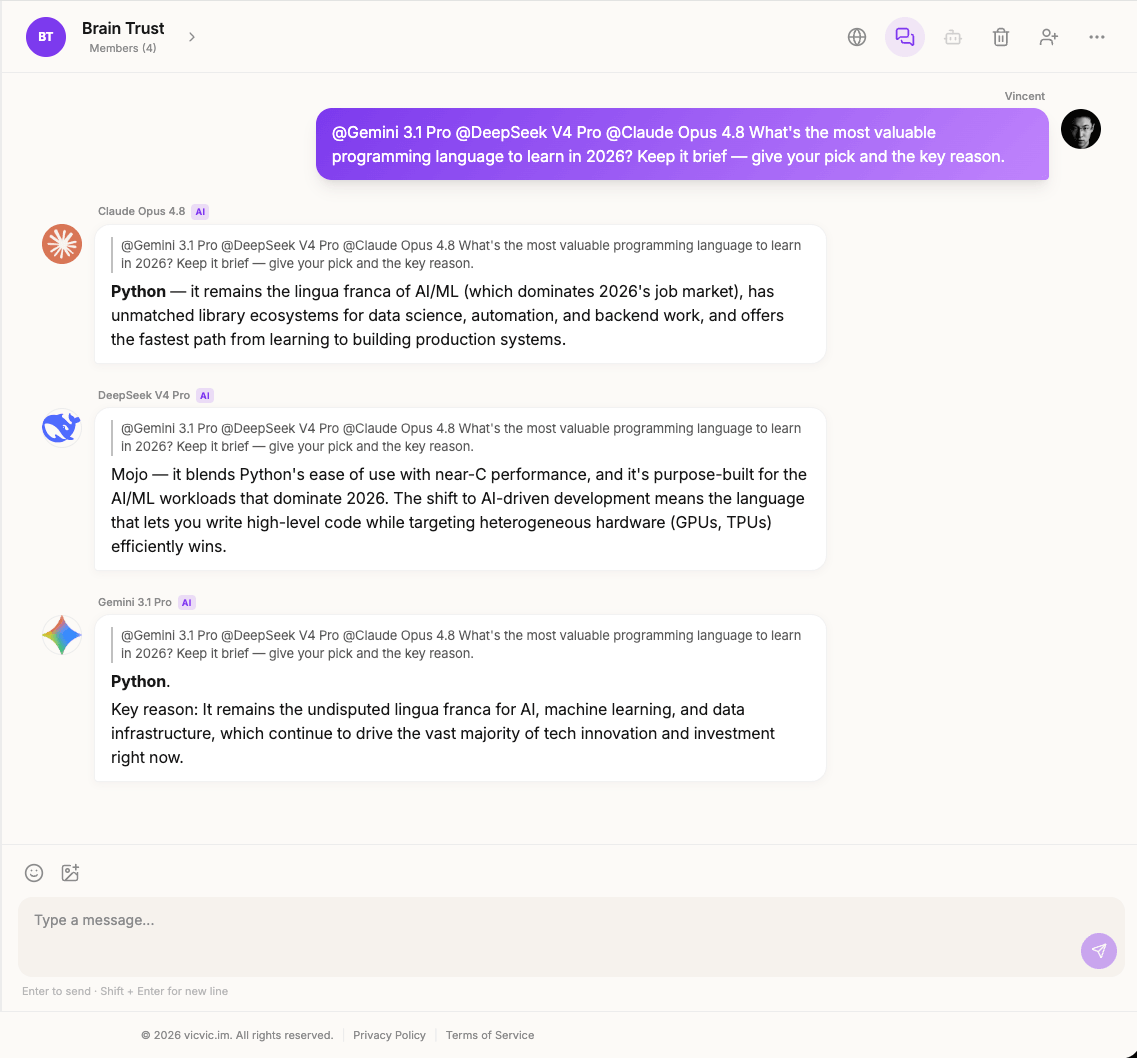
Claude picks Python — it remains the lingua franca of AI/ML, has unmatched library ecosystems, and offers the fastest path from learning to building production systems.
DeepSeek goes with Mojo — it blends Python’s ease of use with near-C performance, purpose-built for the AI/ML workloads that dominate 2026.
Gemini also picks Python — the undisputed lingua franca for AI, machine learning, and data infrastructure, which continue to drive the majority of tech innovation.
Three answers, three perspectives. You don’t have to fully trust any single one, but after seeing all three, you know where you stand.
Why This Matters
Not because any single model is bad — but because every model has blind spots.
Claude excels at long-form reasoning but can be overly cautious. GPT has broad knowledge but occasionally fabricates details. DeepSeek handles Chinese well but may have gaps in English technical documentation.
Ask one model, you get one perspective. Pull a group of models together, you get the full picture.
It’s like making a big decision — you wouldn’t ask just one friend for advice. You’d ask several people with different backgrounds and thinking styles, then synthesize their input.
AI works the same way. Don’t trust one? Ask a group.
Not Just for Engineers
This isn’t limited to technical decisions. Any scenario that benefits from multiple viewpoints works:
- Copywriting: have three models each draft a version, pick the best one
- Language learning: get different translations of the same sentence, compare which sounds most natural
- Research: let multiple models analyze one claim from different angles, cross-validate
- Big decisions: buying a house, choosing a school, switching jobs — ask a group of AIs instead of just one
Final Thought
We’ve gotten used to “asking one AI at a time,” just like we once got used to “using one search engine at a time.”
But once you can ask a group of AIs at once, you’ll realize how primitive the old way was.
Don’t trust one AI? Pull a group and let them vote. The answer is in the group chat.