
Electron in Practice: Customizing Mac Menus
Table of Contents

Preface
Previous articles covered developing an Electron app through to Mac packaging.
Related articles:
Electron in Practice: Local Database SQLite
Electron in Practice: Managing Electron Projects with Monorepo
Electron in Practice: Mac Packaging
Electron in Practice: Registering an Apple Developer Account
Electron in Practice: Mac App Signing and Notarization
Electron in Practice: Customizing DMG Installers
This article covers customizing Mac menus.
Default Mac Menu
When developing a Mac app with Electron,
if you don’t customize the Mac menu,
the default looks like this:
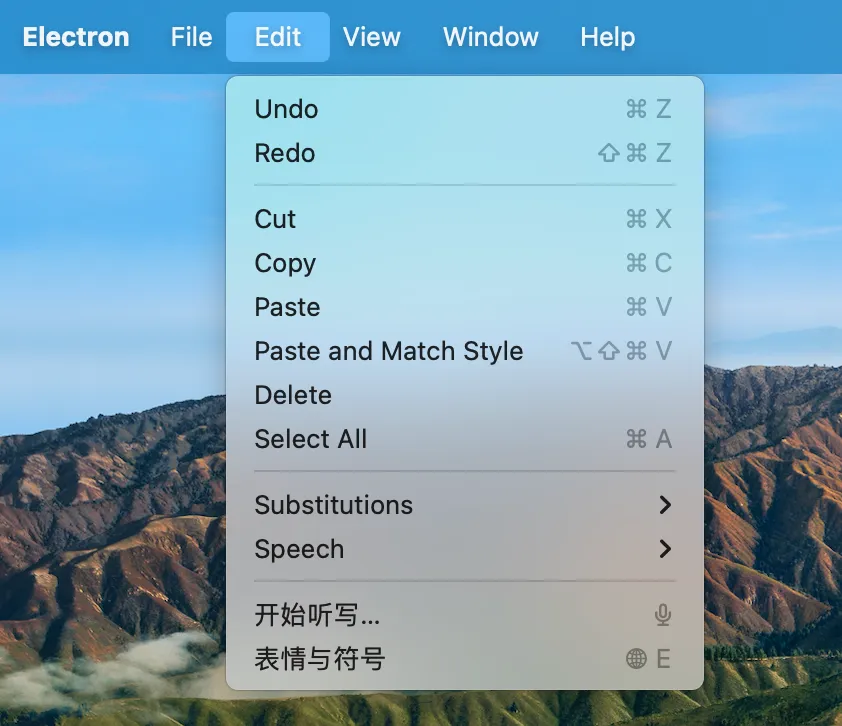
Menu
You can customize the Mac menu bar using Electron’s Menu API.
https://www.electronjs.org/zh/docs/latest/api/menu
The core code is as follows, where template is a menu template array:
const menu = Menu.buildFromTemplate(template);
Menu.setApplicationMenu(menu);
Using Built-in Roles
A common approach in menu templates is to use built-in roles.
Electron wraps common menu items and their click actions into roles:
[
  {
    label: "Edit",
    submenu: [
      { role: "undo" },
      { role: "redo" },
      { type: "separator" },
      { role: "cut" },
      { role: "copy" },
      { role: "paste" },
    ],
  },
];
For example, the copy role above will perform a copy operation when clicked.
Using Custom Menu Items
In addition to built-in roles, you can define custom menu items:
[
  {
    role: "help",
    submenu: [
      {
        label: "Learn More",
        click: async () => {
          const { shell } = require("electron");
          await shell.openExternal("https://electronjs.org");
        },
      },
    ],
  },
];
Common Template
Here is a common template based on typical Chinese app menus:
[
  {
    label: "app",
    submenu: [
      {
        label: "About",
        role: "about",
      },
      {
        type: "separator",
      },
      {
        label: "Hide",
        role: "hide",
      },
      {
        label: "Hide Others",
        role: "hideOthers",
      },
      {
        type: "separator",
      },
      {
        label: "Quit",
        role: "quit",
      },
    ],
  },
  {
    label: "Edit",
    submenu: [
      {
        label: "Undo",
        role: "undo",
      },
      {
        label: "Redo",
        role: "redo",
      },
      {
        type: "separator",
      },
      {
        label: "Cut",
        role: "cut",
      },
      {
        label: "Copy",
        role: "copy",
      },
      {
        label: "Paste",
        role: "paste",
      },
      {
        label: "Delete",
        role: "delete",
      },
      {
        label: "Select All",
        role: "selectAll",
      },
    ],
  },
  {
    label: "Window",
    submenu: [
      {
        label: "Minimize",
        role: "minimize",
      },
      {
        label: "Close",
        role: "close",
      },
      {
        label: "Toggle Fullscreen",
        role: "togglefullscreen",
      },
    ],
  },
  {
    label: "Debug",
    submenu: [
      {
        label: "DevTools",
        role: "toggleDevTools",
      },
    ],
  },
];
Result
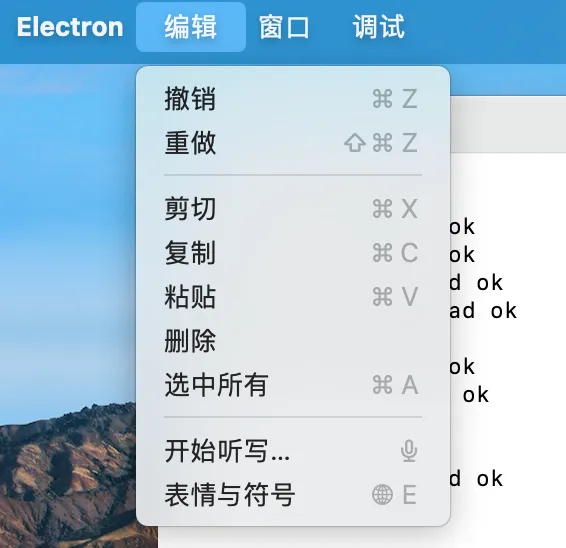
qiao-x-menu
A library for working with Electron menus has been created — feel free to use it:
https://code.insistime.com/#/qiao-x-menu
The menu customization above can be simplified to:
import { setApplicationMenu } from "qiao-x-menu";

setApplicationMenu(menus);Related Articles
Electron in Practice: Local Logging
Preface: After developing a local app with Electron, local logging is essential. It helps capture user actions and locate bugs. Local logs differ from real-time analytics — they are larger, more detailed, and not all information is suitable for reporting. Similarities and Differences with Node.js Logging: Writing local logs in Electron is similar to Node.js.
Electron in Practice: Registering Shortcuts
Preface: This article introduces how to register keyboard shortcuts in an Electron app. Main Process: Registering shortcuts in the main process is straightforward — just make sure to do it after app ready. Common key mappings: https://www.electronjs.org/docs/latest/api/accelerator. Also remember to unregister all shortcuts when the app quits.
Electron in Practice: Update Strategies
Preface: After developing a desktop app with Electron, the next question is how to update subsequent versions. This article introduces several update strategies. Electron Architecture: An Electron desktop app consists of several parts: the Electron runtime itself, the main process (Node.js and non-Node.js parts), and the renderer process.
Electron in Practice: Package Size Optimization
Preface The previous articles covered developing an Electron app through to Mac packaging. Related articles: Learn Electron in One Article, Electron in Practice: Local Database SQLite, Electron in Practice: Managing Electron Projects with Monorepo, Electron in Practice: Mac Packaging, Electron in Practice: Register
Electron in Practice: DMG Installer Customization
Preface A dmg file is a common installer format on Mac. The previous articles have already developed and packaged an application using Electron. This article focuses on customizing the dmg installer.