
Electron in Practice: Package Size Optimization
Table of Contents

Preface
The previous articles covered developing an Electron app through to Mac packaging.
Related articles:
Electron in Practice: Local Database SQLite
Electron in Practice: Managing Electron Projects with Monorepo
Electron in Practice: Mac Packaging
Electron in Practice: Registering an Apple Developer Account
Electron in Practice: Mac App Signing and Notarization
Electron in Practice: DMG Installer Customization
This article covers application package size optimization.
Package Structure
To discuss package size optimization,
we first need to look at the package structure.
On Mac, find a package, right-click, and select “Show Package Contents”.
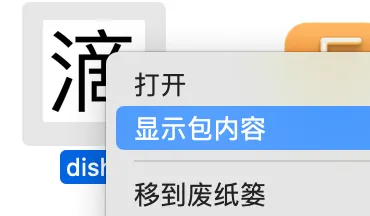
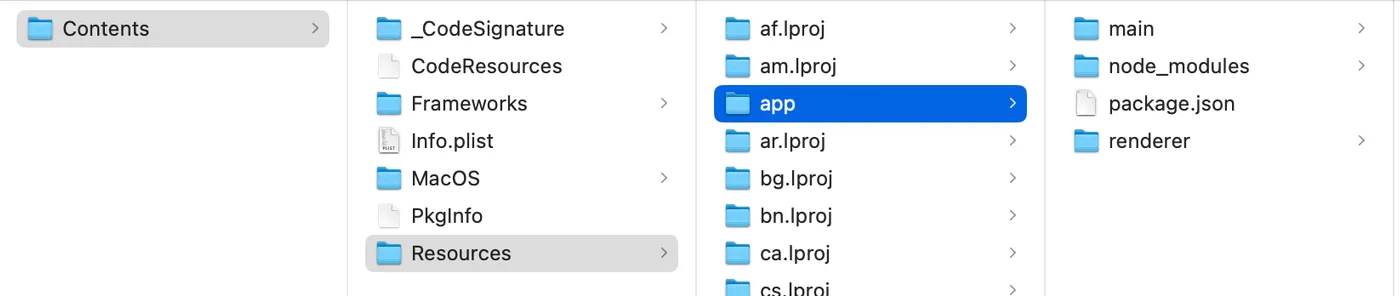
You can see that Contents-Resources-app contains the actual code resources.
The rest are Electron-related environment resources.
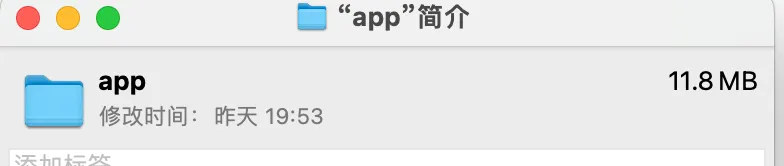
Currently the app folder is 11.8M in size.
The node_modules folder within it is 11.7M.
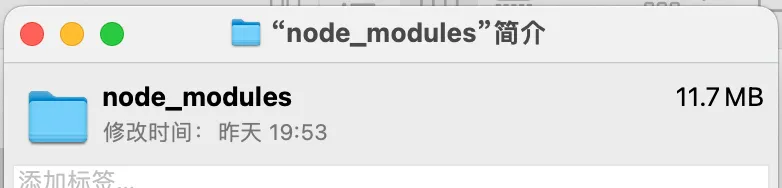
So the simplest way to reduce package size is to not include node_modules.
node_modules
Currently the app folder contains the following:
main: main process code
renderer: renderer process code
package.json: configuration file
node_modules: packages that the main process code depends on
In this article, the renderer process code was already built,
and the build output was copied to the renderer folder under dishi-main.
Electron in Practice: Managing Electron Projects with Monorepo
This means the renderer folder above is already a build artifact.
Now we need to also turn the main folder (main process code) into a build artifact.
This way, the node_modules folder is no longer needed.
The approach chosen here is ES6 + rollup for bundling.
Related Articles
Electron in Practice: Local Logging
Preface: After developing a local app with Electron, local logging is essential. It helps capture user actions and locate bugs. Local logs differ from real-time analytics — they are larger, more detailed, and not all information is suitable for reporting. Similarities and Differences with Node.js Logging: Writing local logs in Electron is similar to Node.js.
Electron in Practice: Registering Shortcuts
Preface: This article introduces how to register keyboard shortcuts in an Electron app. Main Process: Registering shortcuts in the main process is straightforward — just make sure to do it after app ready. Common key mappings: https://www.electronjs.org/docs/latest/api/accelerator. Also remember to unregister all shortcuts when the app quits.
Electron in Practice: Update Strategies
Preface: After developing a desktop app with Electron, the next question is how to update subsequent versions. This article introduces several update strategies. Electron Architecture: An Electron desktop app consists of several parts: the Electron runtime itself, the main process (Node.js and non-Node.js parts), and the renderer process.
Electron in Practice: Customizing Mac Menus
Preface: Previous articles covered developing an Electron app through to Mac packaging. Related articles: Learn Electron in One Article, Electron in Practice: Local Database SQLite, Electron in Practice: Managing Electron Projects with Monorepo, Electron in Practice: Mac Packaging, Electron in Practice: Registering an Apple Developer Account.
Electron in Practice: DMG Installer Customization
Preface A dmg file is a common installer format on Mac. The previous articles have already developed and packaged an application using Electron. This article focuses on customizing the dmg installer.