
Claude Code /usage: Are You About to Hit the Rate Limit?

Table of Contents
- Why You Need /usage
- What Is /usage
- Understanding the Quota System
- Quota by Plan
- Shared Quota Pool
- Tokens Add Up Fast
- Comparing Usage-Related Commands
- Practical Scenarios
- Scenario 1: Check Before a Long Session
- Scenario 2: Rate-Limited? Check When It Resets
- Scenario 3: Align Quota Across Products
- Tips for Saving Quota
- Tip 1: Compress Context with /compact
- Tip 2: Use /clear Promptly
- Tip 3: Switch Models
- Tip 4: Make Good Use of CLAUDE.md
- Advanced: Real-Time Usage in the Status Bar
- Final Thoughts

Why You Need /usage
What’s the worst thing that can happen when coding with Claude Code?
It’s not an unfixable bug or an impossible feature request — it’s getting rate-limited right in the middle of your work.
Claude Code’s Pro and Max subscriptions come with usage limits, and all Claude products (Claude.ai, Claude Code, Claude Desktop) share the same quota pool. Spend half the day chatting on the web interface, and you might find your terminal quota nearly drained.
How do you know how much quota you have left? That’s exactly what /usage is for.
What Is /usage
/usage is a built-in slash command in Claude Code that shows your current usage and quota status.
In interactive mode, simply type:
/usageIt displays your consumption within the current rate-limit window, including:
- Used quota: How much you’ve consumed in the current window
- Remaining quota: How much you have left
- Reset time: When the rate-limit window refreshes
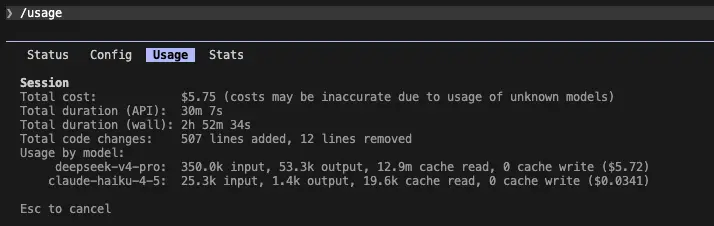
In short, /usage answers one question: How much can I still use?
Understanding the Quota System
Before diving into how to use /usage, let’s understand how Claude Code’s quota system works.
Quota by Plan
| Plan | Quota Multiplier | Approx. Tokens (per 5 hours) |
|---|---|---|
| Pro | 1x | ~44,000 tokens |
| Max 5x | 5x | ~88,000 tokens |
| Max 20x | 20x | ~220,000 tokens |
Shared Quota Pool
Key point: All Claude products share the same quota. Your consumption on the Claude.ai web interface and in the Claude Code terminal draw from the same account.
That’s why sometimes you think “I barely used Claude Code, how am I already at the limit?” — it’s probably because you spent a bunch of tokens asking questions on the web earlier.
Tokens Add Up Fast
A seemingly simple operation like “edit this file for me” can actually consume 50,000 to 150,000 tokens. Every interaction in Claude Code sends the system prompt, conversation history, file contents, and tool call results — all of which count as tokens.
On top of that, a single Claude Code instruction can trigger multiple API calls: reading files, editing code, running tests, fixing bugs, running tests again — a simple “fix lint errors” command might generate 8 to 12 API calls behind the scenes.
Comparing Usage-Related Commands
Claude Code has several usage-related commands — don’t mix them up:
| Command | Purpose | Best For |
|---|---|---|
/usage | Check quota progress and remaining allocation | Pro / Max subscribers |
/cost | View token consumption and cost for current session | API pay-as-you-go users |
/stats | View usage patterns and statistics | All users |
/context | Check current context window utilization | All users |
/usage: How much quota do I have left? (quota dimension)/cost: How much did this session cost? (cost dimension, API users only)/stats: What do my usage patterns look like? (statistics dimension)/context: How much room is left in the current context window? (context dimension)
Practical Scenarios
Scenario 1: Check Before a Long Session
Before starting a big task, run /usage to make sure you have enough quota. Nothing’s more frustrating than getting rate-limited halfway through.
/usageIf you’re running low, consider:
- Waiting for the rate-limit window to reset before starting
- Switching to the Sonnet model to save quota:
/model sonnet
Scenario 2: Rate-Limited? Check When It Resets
Hit a rate limit unexpectedly? Run /usage to see the reset time.
The rate-limit window is typically 5 hours. Once it resets, your quota restores automatically. In the meantime, you can:
- Work on tasks that don’t require Claude Code
- Review your recent conversations for optimization opportunities
Scenario 3: Align Quota Across Products
You’ve been chatting extensively on Claude.ai and are about to switch to Claude Code for some real work. Check first:
/usageSee how much is left. Don’t burn through your quota on the web and then discover you can’t write a single line of code in the terminal.
Tips for Saving Quota
Tip 1: Compress Context with /compact
As conversations grow longer, each interaction consumes more tokens. Use /compact to compress the context — it significantly reduces token consumption for subsequent messages.
/compactTip 2: Use /clear Promptly
After completing a task, use /clear to reset the context before starting a new one. Don’t pile everything into a single conversation — the longer the context, the higher the cost per interaction.
Tip 3: Switch Models
Not every task needs Opus. For simple code edits and formatting tweaks, Sonnet is more than enough — lower consumption, faster responses. See /model for details.
/model sonnetTip 4: Make Good Use of CLAUDE.md
Document your project’s architecture, coding standards, and common commands in CLAUDE.md. This way you don’t have to describe the background in every conversation — saving those tokens for what actually matters.
Advanced: Real-Time Usage in the Status Bar
Running /usage manually every time is tedious. You can display usage information in real time right in the status bar.
Configure the status option in Claude Code’s settings to show quota information at the bottom of your terminal. This way you can always see your remaining quota without interrupting your workflow.
Final Thoughts
/usage solves a simple problem: keeping you informed about your quota.
When developing with Claude Code, tokens are your fuel. Hitting the road without knowing how much gas you have left means you’ll eventually break down mid-journey.
Build the habit — check /usage before starting work, check /usage during long sessions, check /usage when you get rate-limited. Three words: stay informed.
One command to avoid every “suddenly rate-limited” surprise.
Related Articles
Claude Code Agent Loop: Dissecting the Heart of an AI Coding Assistant
How does Claude Code understand your requests, invoke tools, and self-recover step by step? A source-code deep dive into the Agent Loop's core architecture — streaming responses, parallel tool execution, auto-compaction, and error recovery.
Claude Code settings.json Hooks: Auto-Run Scripts at Every Step
Want to auto-validate commands before they run? Send Slack notifications when tasks finish? Claude Code hooks let you inject custom scripts at key moments — PreToolUse, PostToolUse, Stop, Notification — with practical examples.
Where Is Claude Code settings.json? 5 Config Files, 1 Priority Rule
Claude Code has 5 config file locations: user-level (~/.claude/), project-level (.claude/), local-only, CLI flags, and enterprise managed settings. Learn which file to use when, how priority works, and why your settings might be ignored.
Claude Code settings.json: Copy-Paste Templates for env, model, auth & More
Ready-to-use Claude Code settings.json snippets for env vars, model switching, apiKeyHelper auth, git signing, effort level, language, auto-updates, and more. Every field includes a working JSON example you can copy and paste.
Claude Code settings.json Permissions: Control Exactly What AI Can Do
Stop clicking 'Allow' on every action. Configure Claude Code's permissions system — set allow/deny/ask rules, use wildcards, control MCP tools, and protect sensitive directories. Every permission option with practical examples.